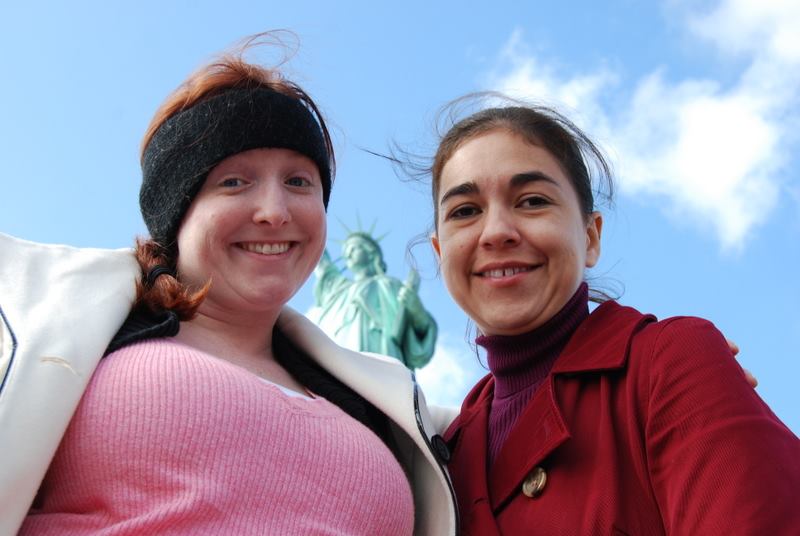
Jason and Estela invited me on a trip to New York.
New York City.
The New York I had been promised by movies and television.
The You’ve Got Mail New York, where Meg Ryan owns a charming bookstore and Tom Hanks falls in love with her, and somehow the IRS never intervenes.
The Sex and the City New York, where everything is glamorous and chic and no one ever has roommates they actively resent.
The Friends New York, where everyone lives across the hall from each other, no one locks doors, and rent is apparently paid in jokes.
The Seinfeld New York, where the worst thing that happens is someone double-dipping a chip and that’s enough to ruin an entire episode.
New York was supposed to be magical. Romantic. Fast-paced. A city where you might bump into destiny on the sidewalk while carrying a latte you’re emotionally attached to.
I had been absorbing this marketing campaign my entire life.
So, when I was invited to New York, I said yes.
The plan was a week in the city. Sightseeing. Incredible food. Broadway.
What the marketing materials did not disclose were the footnotes.
Footnote one: Estela—five months postpartum—was running the New York City Marathon.
This woman had recently survived preeclampsia, which is what happens when your body quietly tries to kill you while doctors say things like, “That’s normal discomfort.” She complained of pain. This woman who climbed mountains for fun. The doctors ignored her.
Turns out the pain she was feeling was her liver failing.
Her baby, Benjamin, arrived early and small. Thankfully, everyone pulled through. Estela is tough—apparently forged from some rare, indestructible metal. Possibly vibranium.
So tough, in fact, that she trained through her entire pregnancy and was registered to run one of the most famous marathons in the world.
Footnote number two: we were traveling with a baby.
I really should have seen that part coming.
I have never liked babies. I am uncomfortable around babies. I didn’t even want baby dolls as a child. I was insulted when given one, as though the gift-giver had fundamentally misunderstood me.
And this baby—Benjamin—adored me.
When people took pictures of him, I was often positioned closest to the camera because I made him smile. I suspect he sensed my discomfort and was feeding on it.
An evil baby.
A charismatic one.
Then—after everything was booked—I learned the final footnote.
We would not be staying in a hotel.
We would be staying with Estela’s father.
In New Jersey.
This was…new information.
Jason and I share a deep spiritual belief: we do not stay in other people’s homes.
We like keys. Locks. Neutral smells. Privacy.
Hotels understand boundaries.
And to top it off, not only were we staying in someone else’s home, we were staying in the home of a stranger. Estela’s father was not a father so much as a biological hit-and-run. He’d left Estela’s mother and their four young children to live full-time with his secret second family.
I had no idea why she wanted to see him. She hardly knew him.
And I had no idea how I was supposed to be polite to him.
But Estela was not changing her mind.
A few days before we left, Estela was taking her motorcycle out of the garage—a fairly new hobby, encouraged by Jason—when she dropped it.
On her foot.
It was determined she had broken a bone in the top of her foot. Pain. Swelling. Bruising. Difficulty walking. No cast. No boot.
She would simply have to tough out this pain too.
She cancelled her spot in the marathon.
But the trip—with our non-refundable tickets—was still on.
So now we were going to New York for a marathon no one was running, to stay with a man I resented on principle, with a newborn, in October.
This felt…ominous.
American Psycho ominous.
At the airport, Estela’s father and his new wife—number three? four?—picked us up. That’s when I learned they spoke no English. None.
My Spanish, which was already shaky, had been beaten out of me by years of workplace exploitation. Once the receptionist discovered I spoke Spanish, every call from a Spanish speaker was routed to me. Payroll? Insurance? Tech support? Me.
Soon she got comfortable enough to route any caller with an accent to me—even when they spoke perfect English—and I’d have to apologize for my coworkers’ ignorance before redirecting the call.
I eventually refused to take any more Spanish calls out of sheer anxiety.
So this was going to be a very long week—playing nice with a man I despised on principle, trying to communicate in a language that made my lip sweat.
His apartment was an old tenement—three bedrooms stitched together like a bad facelift. You had to walk through one room to get to the next. No doors. No privacy. The bathroom had clearly been added later to satisfy a law. The floor sloped slightly, as though the entire addition was considering resignation.
And the walls were paper thin.
Paper.
Thin.
Breakfast at Tiffany’s never warned me about that.
I tried to stay upbeat. I really did. If this trip imploded, I didn’t want it to be blamed on my attitude.
But things were not working out quite like I had expected.
It was cold. Wet. Drizzly. Bone-aching, humid cold—the kind that seeps into your joints and files a formal complaint.
Still, we did the tourist things. Statue of Liberty. Empire State Building. Times Square. Wicked—which was spectacular. The sets alone deserved a standing ovation.
Jason didn’t want to see the show, but he stayed close so Estela could breastfeed Benjamin during intermission, because Broadway magic does not pause for lactation.
Watching New Yorkers react to a baby was fascinating. People unfazed by honking horns, shouting, and the relentless press of bodies would stop dead at the sight of a stroller. Confusion followed—then smiles or scowls. No middle ground.
We learned New York is not baby-friendly in a way Three Men and a Baby absolutely lied about.
There was nowhere convenient to change diapers. Nowhere to breastfeed. Nowhere to sit.
At Katz’s Delicatessen—Where Harry Met Sally—I still dream about the pastrami while simultaneously having nightmares of Estela plopping Benjamin on the table and changing a full diaper right there.
Not because she wanted to.
Because there were no better options.
And it wasn’t just diapers.
Babies don’t just poop. They weaponize their bodies.
Benjamin produced sounds no adult should survive making. Wet, explosive, deeply personal sounds—like someone stepping on a lasagna in a church basement. Sometimes it came with warning. Sometimes it did not. Sometimes it came with eye contact.
There was spit-up. Not a gentle dribble. A full, curdled milk geyser that smelled faintly sweet and deeply wrong. The kind that seeps into fabric and lives there now. You don’t wash it out—you negotiate with it.
At one point, Estela calmly announced, “He blew out,” which I learned is baby code for everything has failed. Diaper. Onesie. Pants. Physics.
They handled it the way all parents do: panic first, then logistics.
We were in public. Of course we were. We were always in public. New York does not provide discreet spaces for bodily emergencies. New York wants you to experience shame at full volume.
On Halloween, Estela put Benjamin in a little jumpsuit with a hood so he looked like a monkey. On the subway, an elderly woman was so delighted she gave him a dollar bill, which felt both generous and deeply confusing.
As we exited the station, we were still laughing about it when a fellow passenger suddenly blurted out,
“How are you not seeing this?!”
He gestured wildly ahead of us.
Crossing our path was a raccoon the size of a medium dog. No—larger. Confident. Unbothered. Lumbering with the authority of a creature that had filed the necessary paperwork.
This was not a cute woodland raccoon.
This was an urban raccoon.
A raccoon that paid rent.
A raccoon with opinions.
Call in Godzilla.
This was no longer You’ve Got Mail.
This was a monster movie.
That night there was a blues dance. I braved the city alone, in the rain, and found the venue. I walked upstairs wet, tired, and worn down. The music was familiar. The dance was comforting.
I danced one song with a man who introduced himself as Jewish.
“Hi, I’m Diana.”
That was it. The entire interaction.
I did not love New York. Sorry, Hollywood. Sorry, New York City marketing team. I will not be buying your I ❤️ NYC merchandise.
It was too big. Too loud. Too many people.
And it smelled like urine.
Probably because of all the urine.
The movies never warned me about the urine.
There were puddles of it—in the streets, in the subway, in the subway cars, in the elevators. Elevators we had to take because of the stroller.
This was not the Manhattan of The Muppets.
Then Estela’s father announced we were going to the Poconos.
And we were offered no veto.
The Poconos is a popular destination in northeastern Pennsylvania, known for skiing in winter, hiking in summer, and absolutely nothing in the cold, drizzly rain of October.
We spent two days stranded in the middle of nowhere, in the sperm donor’s second home, with nothing to do, nothing to see, and people I did not like.
We couldn’t go anywhere—they had the only car. And they insisted on cooking instead of going out. They were worse cooks than I am, which is saying something. We had a breakfast made of runny eggs and hot dogs, served with coffee that tasted both burnt and weak.
There should be more horror movies set in the Poconos.
Maybe I would like New York if it were all Broadway shows and Brooklyn pizza.
But it isn’t.
And I still haven’t forgiven the movies for lying to me.
This was not Sex and the City.
No one was fabulous.
No one wore heels.
And if Carrie had stepped in the puddles we did, she’d have gone home barefoot and reconsidered her life choices.
New York didn’t make me want to reinvent myself.
It made me want to get back to real life—
where the bathrooms are predictable and life is terrible in familiar ways.
Leave a Reply