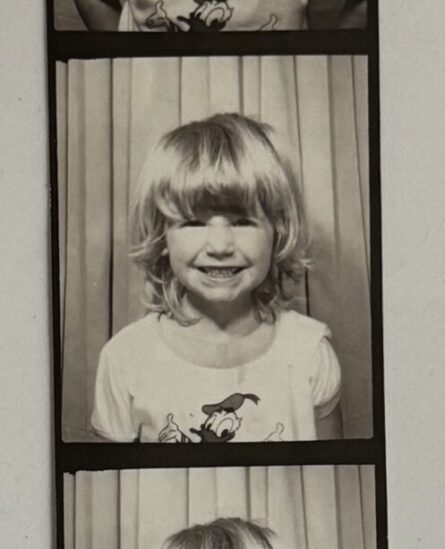
A proper Mormon child gets baptized at eight—the age, they teach, when you officially become accountable for your sins.
In my case my sins included fighting with my brothers, coveting the neighbor’s Barbie Dream House, and one particularly scandalous crime: washing myself “down there” in the bathtub without a washcloth.
My mother had once caught me mid-suds and reacted like I’d committed treason against the state. Suddenly, my little hand was Public Enemy No. 1.
I was told never—never—to touch myself there.
Which, as you might imagine, led to some very creative interpretations of hygiene in the years that followed. Let’s just say there were entire regions of my body that went uncharted longer than the Pacific.
But let me warn you up front, we weren’t a “proper” Mormon family.
And I wasn’t baptized until I was almost nine.
Which, in the heavily Mormon city where I lived in, was practically a scandal.
Religion simply wasn’t a priority in our house. Church attendance was a special event—like Olympic years, or Halley’s Comet.
But I wasn’t a total heathen.
I knew a few hymns. I knew the basic prayer recipe: “Dear Heavenly Father,” gratitude salad, vague promises, “in the name of Jesus Christ, amen.”
And I knew the broad outline of Heavenly Father’s plan for me.
Be pure. Be clean. Be virtuous. Get married young. Have babies.
Lots of babies.
A career? Not really part of the suggested itinerary. Ambitions? Depends what you mean. A big life? Sure—as long as it fit neatly inside the approved blueprint.
Church and babies would make God happy.
And, presumably, making God happy would make me happy.
I was not a fan of that plan.
So I was not, unsurprisingly, a huge fan of church. But I tolerated it, as required.
I remember being asked to give a talk in Primary—the children’s Sunday class, where we learned the basics of Mormonism and, apparently, how to identify acceptable heroes.
The topic of my speech was “My Hero.”
I took it very seriously.
I wrote a speech. Memorized it. Rehearsed it for my mother while standing on our fireplace mantle, because apparently even at that age I understood the importance of dramatic staging.
Come Sunday, after the leader introduced me as the next speaker, I marched up front of the room of gathered children, wearing the pinkest, froofiest dress in existence and stood behind the miniature sized pulpit and delivered my enthusiastic five-minute tribute…
to Oprah.
I don’t remember the adults’ reactions, but retroactively, I assume there was fainting. Maybe a small stroke.
This was Orem, Utah, land of white, middle-class, patriarchal uniformity. These people were expecting Spencer W. Kimball (the church leader at the time), Joseph Smith (the founder of said church), or, at minimum, Jesus.
Instead, they got me, reporting live from the Church of Daytime Television.
If I’d come with a warning label, it would’ve said:
May Contain Traces of Feminism.
So it should shock absolutely no one that when my baptism finally arrived, I had no idea what was actually supposed to happen.
I remember being called in to speak to the bishop. We went to church that Sunday, and after the meetings ended Mom escorted me to the hallway where his office was located, and she ushered me inside. I sat in a folding chair facing him behind his desk, my mom perched in a chair next to me, holding my hand.
He asked if I wanted to get baptized.
I looked to my Mom, and she nodded vigorously.
I said, “Yes?”
I knew I’d get a new dress—a fondness for which I have had my entire life—and that extended family would show up and pretend I suddenly mattered for forty-five minutes.
Cake. Attention. New outfit.
Absolutely.
Dunk me, Daddy.
Well, normally it would be the father who does the ceremonial dunking, however, my father did not attend church, and did not pay his heavenly bribe of 10% of his income, and was therefore NOT allowed to perform the baptism that was supposedly going to save my heathen little soul.
On the appointed day, mom drove me to the stake center, which unfortunately does not serve steak.
I zipped up my white baptismal jumpsuit and walked toward my fate.
The baptismal room was nothing fancy. It was the sort of institutional church room that looked designed by people whose primary concern was whether something could be cleaned with bleach. Pale walls. Hard surfaces. Fluorescent lights. A big rectangular font set into the floor, with steps leading down into the water.
It smelled faintly of chlorine, and damp concrete. The baptismal font was in a small room adjoining a larger meeting room, separated by a plastic accordion door that had been pulled open for the occasion. A few of the seats were filled with people I vaguely recognized as relations and neighbors.
The font water was warm.
I remember the white jumpsuit feeling awkward, stiff, and too large as I stepped into what, to my eight-year-old eyes, was basically a tiny swimming pool.
My uncle—one I barely knew and yet fully disliked—stood there waiting for me. Apparently, I hadn’t yet connected the dots that he was the guy who was going to dunk me. I didn’t realize he would be the one I had to associate with for this sacred affair or I might have reconsidered.
He put my hands in the appropriate arrangement. Then came the prayer, the backward lean, the brief underwater world—
and up I came.
Triumphant.
Slightly bewildered.
Like a religious otter.
They handed me a towel and sent me toward the changing room.
I waited for divine electricity.
A warm spiritual buzz.
Something.
Anything.
Nothing.
Even though I had clearly just gotten thoroughly damp in front of a small audience.
Maybe that Jesus Jacuzzi was broken.
So I started getting dressed.
It did not occur to me—nor apparently to any of the adults supervising this sacred rite—that I might need a change of underwear.
A detail so vital, so obvious, so crucial to human comfort, you’d think someone would have mentioned it.
But no.
So there I was, freshly baptized, spiritually reborn, and pulling my new dress over a pair of soaking-wet underpants.
And truly?
That moment was a preview of how much of my life would be.
No instructions.
No warning labels.
And me standing there in something wet, wondering:
Is this… normal?
Maybe I should back up.
Because if you’re going to understand the person who came out of that baptismal room, you need to know the family who sent her in.
I arrived on the scene in January 1980, the third child of two sweet, quiet, conservative parents who considered mild disagreement the equivalent of full-scale rebellion.
Right out of high school, my mother began working for her future mother-in-law, my soon-to-be grandma Leona, in her basement beauty shop.
Two sinks. Two chairs. A battalion of hood dryers in turquoise blue.
Every surface lacquered in a fine mist of hairspray.
A few years after they married, my dad went to work for his father-in-law in a scrap yard: a couple of acres of cars in various stages of decomposition.
The shop smelled like gasoline, paint, and pure American nostalgia.
In other words: heaven.
My parents married young, eventually bought a yellow house on a corner lot conveniently located in a spot geographically located between both sets of their parents, and they still live there to this day.
I have two older brothers, Jason and Alan, and as the youngest—and the only girl—I was spoiled rotten in a way I highly recommend.
As kids, we played outside in a neighborhood where everyone knew everyone’s business. We roamed feral until the streetlights flipped on or Dad’s whistle cut through the air.
We watched only edited-for-TV movies, and even then, my mother kept a dishtowel poised like a moral ninja to slap over the screen if a kiss lasted longer than two Mississippis.
We were sheltered.
If innocence had a ZIP code, we were its premiere residents.
And that’s important to understand, because I grew up in a world where there were plenty of rules.
There just weren’t always explanations.
There were things you did because good girls did them.
Things you didn’t do because good girls didn’t do them.
Things you didn’t ask about because, frankly, why are you asking about that?
And then there were the things nobody thought to tell you.
Like the underwear.
But I’m getting ahead of myself.
Allow me to introduce myself.
I’m Diana.
And, since you’re going to be spending some time with me, there are a few things you should probably know.
If you saw me walking down the street, you’d hear me first—my laugh is loud enough to be heard over the roar of a motorcycle engine (it’s been verified).
Then you’d see me.
Short. Dishwater blond. A little chubby. Pale enough to reflect moonlight. Freckles for seasoning. Roman nose. Narrow lips framing a giant grin. And a complete absence of poker face.
I am emotionally transparent to the point of being a security risk.
And though various parts of me change during the course of this narrative—as do so many things—you should know about the boobs.
H-cups.
Thirty-four H.
Yes, that’s a real bra size.
Imagine two overzealous cantaloupes duct-taped to a soda can.
They got attention.
Way too much attention.
I tried to hide them, bind them, contain them—but those girls were like inflatable tube men outside a used-car lot:
“HEY, YOU! YES, YOU! SAY SOMETHING INAPPROPRIATE! NO, REALLY, DON’T HOLD BACK!”
And, of course, I came by these honestly.
My father’s sister—our infamous “Pretty Auntie Norma”—was mythically endowed. A Double K, practically a local landmark.
At her funeral, I learned that in 1960s San Francisco, she embraced the bra-free lifestyle and got one of her free-roaming boobs wedged in a revolving door, jamming the mechanism so thoroughly that the fire department had to dismantle the whole thing to get her freed.
A job which probably took them longer to accomplish than strictly necessary, because they were all doubled over laughing.
I am still offended I didn’t hear this story until after her death.
In my family, embarrassing stories are communal property.
We gather around the kitchen table and retell them until our sides ache, tears stream, and someone hopefully starts laughing so hard they go hypersonic.
No shame.
No secrets.
Just shared mortification.
It’s not just entertainment.
It’s our family’s official love language.
And that’s probably the best warning I can give you before we begin.
These stories are funny because they happened to me.
Some of them are funny because I have survived them long enough to find the punchline.
A few wander into darker terrain.
But don’t worry.
I make it out alive.
Mostly.
My dignity survives with minor bruising.
If you don’t know me, consider this your orientation packet.
If you do know me, I’m sorry.
You may be a character in here.
You may already be sick of these stories.
Too late now.
And if you are my mother:
STOP READING. IMMEDIATELY.
You’ve been warned.
And that’s the stage set.
Welcome, darling.
Here’s my trauma.
Please enjoy responsibly.